


This is the second story from our 12th issue, themed “THE AFTERLIFE.” Also in this issue: Are Those Skeletons in My Closet?
Happy Halloween, Housemates.
I promised you a two-part creature feature—and hopefully you caught Part 1, Maya Ibbitson’s investigation into the haunted objects of Facebook Marketplace, earlier this week. Today, we’re back with Kevin Greenberg at the wheel, delivering an exorcism of Skelly, the 12-foot pile of bones that has taken over the lawns, stoops, and storefronts of Greater America. Since its introduction in 2020, the $300 Home Depot abomination has sold out each year. Naturally, a small economy has cropped up around it: Skelly now has a range of accessories, ghoulish animal companions, and knockoffs aplenty. (Somehow, even Arby’s is getting in on the action with a giant-sized set of “meat sweats.”) But Kevin argues that Skelly’s proliferation is actually a symptom of a bigger ill: the death of DIY Halloween.
Happy haunting.
—Lila Allen
⌂ ⌂ ⌂
Like what you see here? Want to support independent design media? Wrong House compensates its contributors, and your support goes directly toward producing more stories. Please consider becoming a paid subscriber.
I: Danse Macabre
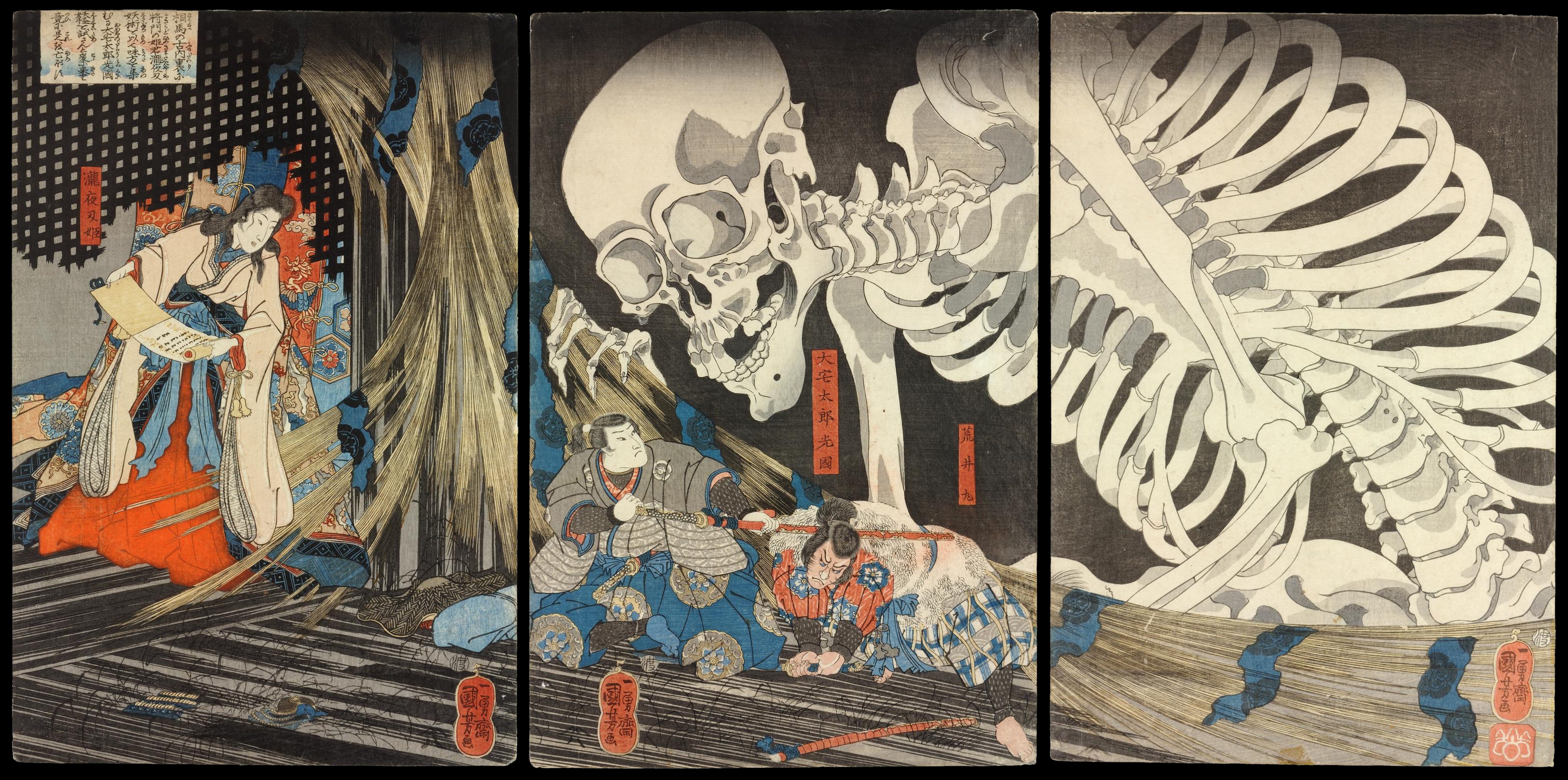
You’ve doubtless seen them: during those glum weeks in late September when it’s still balmy out but people have long since stopped asking how you spent your summer, they begin sprouting up like mushrooms after the rain. Scores of them—these many plastic skeletons, lithesome and lily white, posed mid-clamber on the recently repointed facades of brownstones in Park Slope and Carroll Gardens. Gaudily naked, sightless and slack-jawed, they grimace at passersby from parlor-floor windows and spill from parapets on silvery piano wire, limbs splayed and jangling in the crisp autumn air. As the calendar advances toward the end of October, their numbers seem to multiply with every passing day.
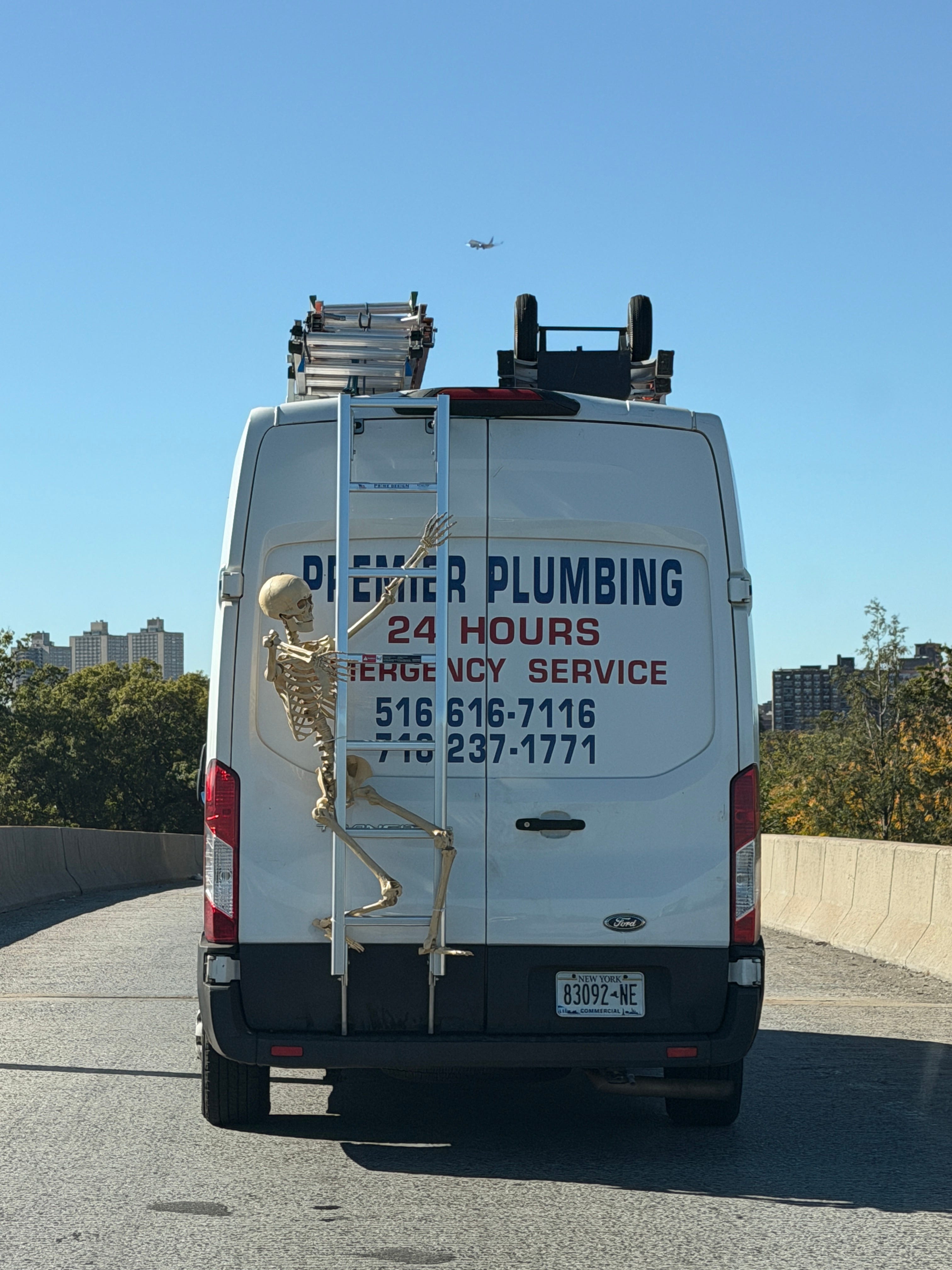
Most you’ll see in the city are roughly life-sized. They are dully accurate, and from a distance they might not look out of place in a high school science classroom, an object lesson in anatomy propped up in a corner beside the requisite oversized periodic table. It’s only when you’re up close in broad daylight that you can see the ragged seams of their hasty, injection-molded construction.
In the context that concerns us here, there are, of course, notable exceptions to the standard format. Some are inexplicably pint-sized or half-scale, or canine, feline, avian or vulpine. Some take on the form of animals that, in reality, don’t even have bones at all. But these exotic variants are the exception, not the rule—recently released ancillaries marketed to enthusiasts who already have the core collection and are after novelty, diversity, or sheer density.
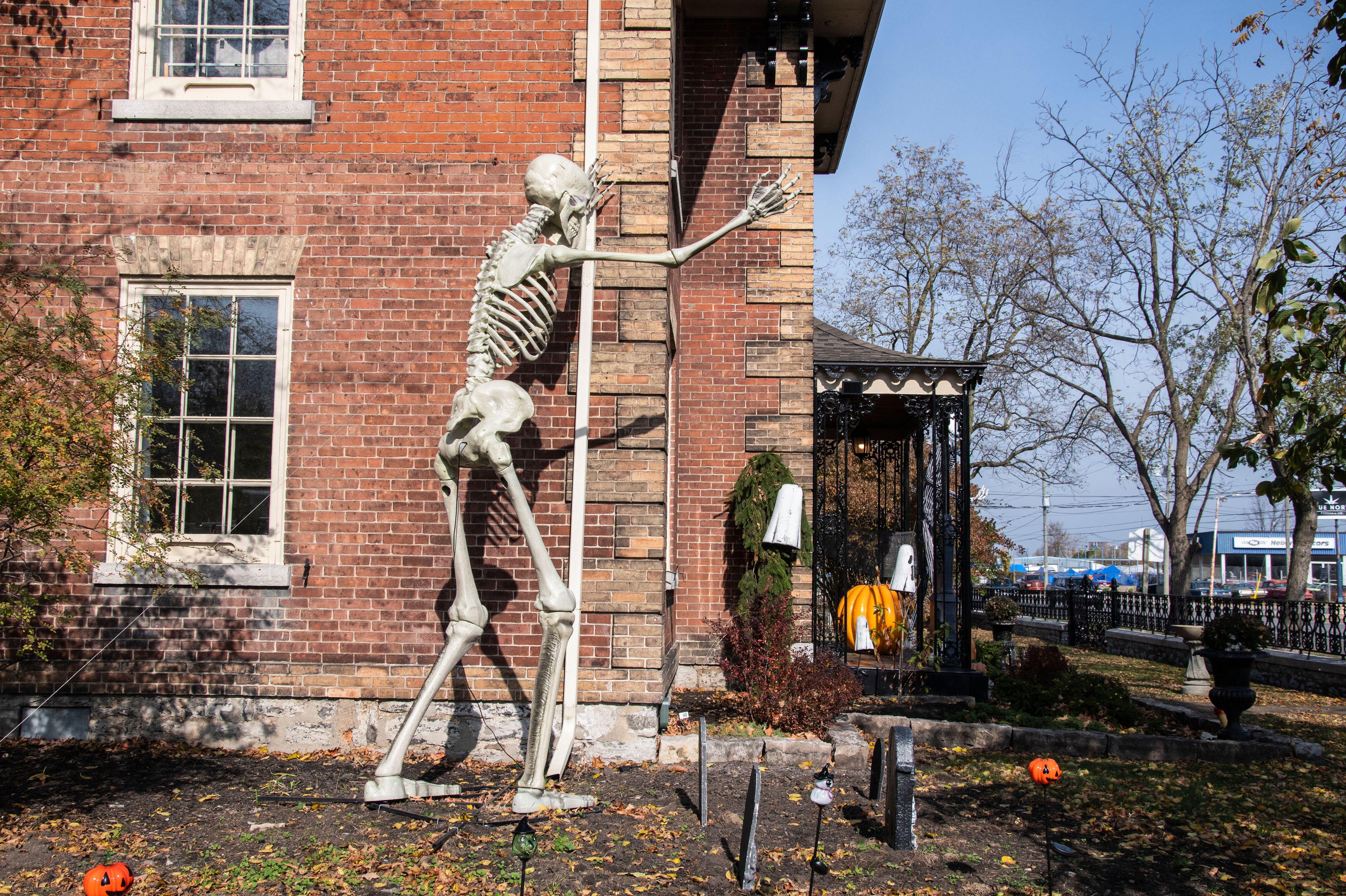
Meanwhile there is one, of course, that quite literally towers over them all: At 12 feet tall and commanding a whopping $300 price tag at its native Home Depot, it has been affectionately dubbed “Skelly” by the triumphant product developers who designed it in 2019 and released it to the public in the summer of 2020. In the years since, along with its more modestly sized plastic brethren, it has quietly and resoundingly conquered Halloween.
–
How did we let this happen? It feels like not that long ago that we were a proud nation of Halloween DIY’ers, armed mostly with glue guns, craft scissors, and old bedsheets as we gazed toward the end of October. More than any other holiday, Halloween was always an opportunity to get crafty with it, both inside the house and out. Well, let’s not be naïve: Certainly, like most other commercial holidays, Halloween has brought with it a sluice of cheap, disposable plastic junk, but some of this reporter’s fondest early childhood memories are of laboring with his friends and his newly single mom over effigies of spiders and ghosts both decoupaged and papier-mâché’d, wearing some unapologetically goofy and cobbled-together costume, while a punch bowl bubbled over with dry-ice fog someplace reassuringly nearby.
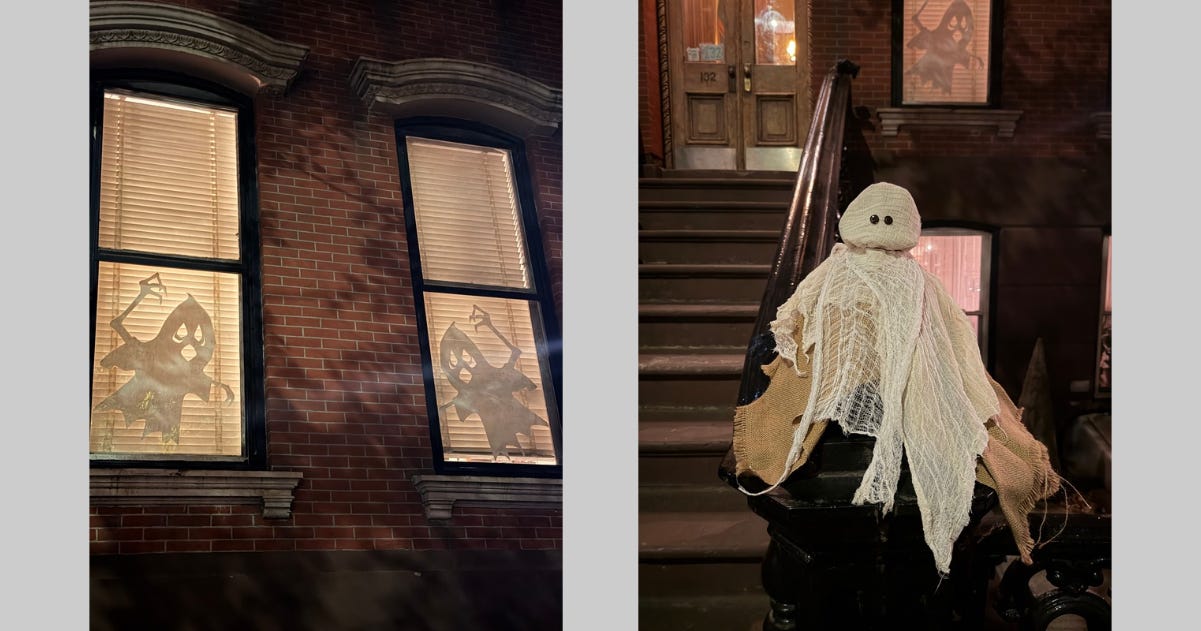
Tempus edax rerum. Now squarely in midlife, each year I find myself confronting a different, decidedly drearier autumnal landscape as I wearily survey my own block. Whither the bunched-up crepe paper ghost, the ambiguously-startled-and-now-majorly-freaked-out black cat, the grinning jack-o’-lantern with its triangulated eyes, the bat made from a humble toilet paper tube and some construction paper? When did the diverse cosmos of homemade decorations of decades past (each evocative of the unique hand and imagination that created it, and as such a de facto celebration of life, as is all art) give way to this perfunctory scourge of mass-manufactured and storebought plastic skeletons strewn everywhere, spat out of anonymous vats halfway across the world and delivered to our shores by the heaping shipping container’s worth? And why have we suddenly decided, seemingly overnight and en masse, that we’re good with giving up on the rich diversity of Halloween decorations of the past in favor of this lone, bland, quasi-realistic signifier—not even of the occult, the supernatural, or the merely spooky, but rather just the banal inevitability of death itself?
It turns out skeletons weren’t always a mainstay of Halloween decor, in America at least. Though Halloween has been celebrated here since the 19th century, it was only in the early 20th that these bony characters began to appear regularly in decoration and party decor catalogs aimed at seasonally-minded homemakers and hostesses. Back then, they primarily took the forms of whimsical articulated paper cut-outs meant for installation on interior walls, most famously marketed (even today, in Skelly’s colossal shadow) by the Pittsburgh-based Beistle Company. Walt Disney’s animated “Skeleton Dance” definitely helped give skeletons a cultural moment in the late 1920s (followed by the much more sophisticated, and, in your correspondent’s view, legit way scarier “Night on Bald Mountain” sequence that brings down the curtain on 1940’s Fantasia), as did the popularization of imported Día de los Muertos imagery in the years after World War II.
But unsurprisingly, as with many of the discontents of modern life, it’s hard not to lay blame for Skelly and its injection-molded antecedents squarely at the feet of late-stage capitalism, as post-war manufacturing advances flooded the consumer marketplace with affordable plastic products all those decades ago. And indeed, during the preparation for the writing of this article, most bystanders asked for a hot take about the sudden surge in the popularity of plastic skeletons pointed to their dubious place in the consumer ecosystem as the most obviously unsavory thing about them. This is such a popular opinion that it’s spawned a groan-worthy meme that’s currently floating around the socials, something to the effect of “giant plastic skeletons are terrible for the environment. Choose locally sourced, organic skeletons instead.”
Haha. But I would submit that The Problem with Skelly transcends the lazy finger-wagging of your average sustainability scold and demands to be engaged with on a deeper level. First, there’s the scale of the damned thing. Like the much-maligned Tesla Cybertruck (“the MAGA hat of the highway,” as I once memorably heard it described), Skelly’s sheer size makes it impossible to ignore. A passerby has no choice but to mentally acknowledge its presence, regardless of whatever might be rattling around in their head at that moment, and to then deal with the resulting toll on morale of having to interface involuntarily if only in passing with a giant anatomically semi-correct skeleton whose owner may or may not have also sprung for the optional motion-sensitive glowing LED eye kit ($28.95) that locks its gaze on you as you pass by, and which can also be programmed to display the American flag in lieu of pupils, among other settings.
And naturally, forcing this unwelcome interaction is, of course, the point of buying and installing it out front of the house in the first place.
As a quick aside, it’s also of course worth at least mentioning Robert Venturi in passing here, which I’m sure most design-adjacent readers suspected was coming, and probably several paragraphs sooner than this. Recalling Venturi’s famous imperative that vernacular decoration should be embraced as an honest, vibrant reflection of the context that created it, maybe Skelly is simply the Venturian denotative symbol our age rightfully deserves.
In light of this angle, to accuse Skelly of being “insensitive to its context” because of its towering size and grotesque features might sound like the pearl-clutching of someone who probably has some skin in the neighborhood-fabric game, or who at least has, on occasion, appeared in a professional capacity before the Landmarks Preservation Commission and who gets hung up on the placement and proportion of scuppers and other architectural foofaraw. But so be it. Like the worst and most aggressive architecture, there is something inherently antagonistic (is it too much to say oppressive?) about this approach to holiday decor, and it’s no wonder Skelly seems to regularly spark conflicts with uppity HOA boards around the nation.
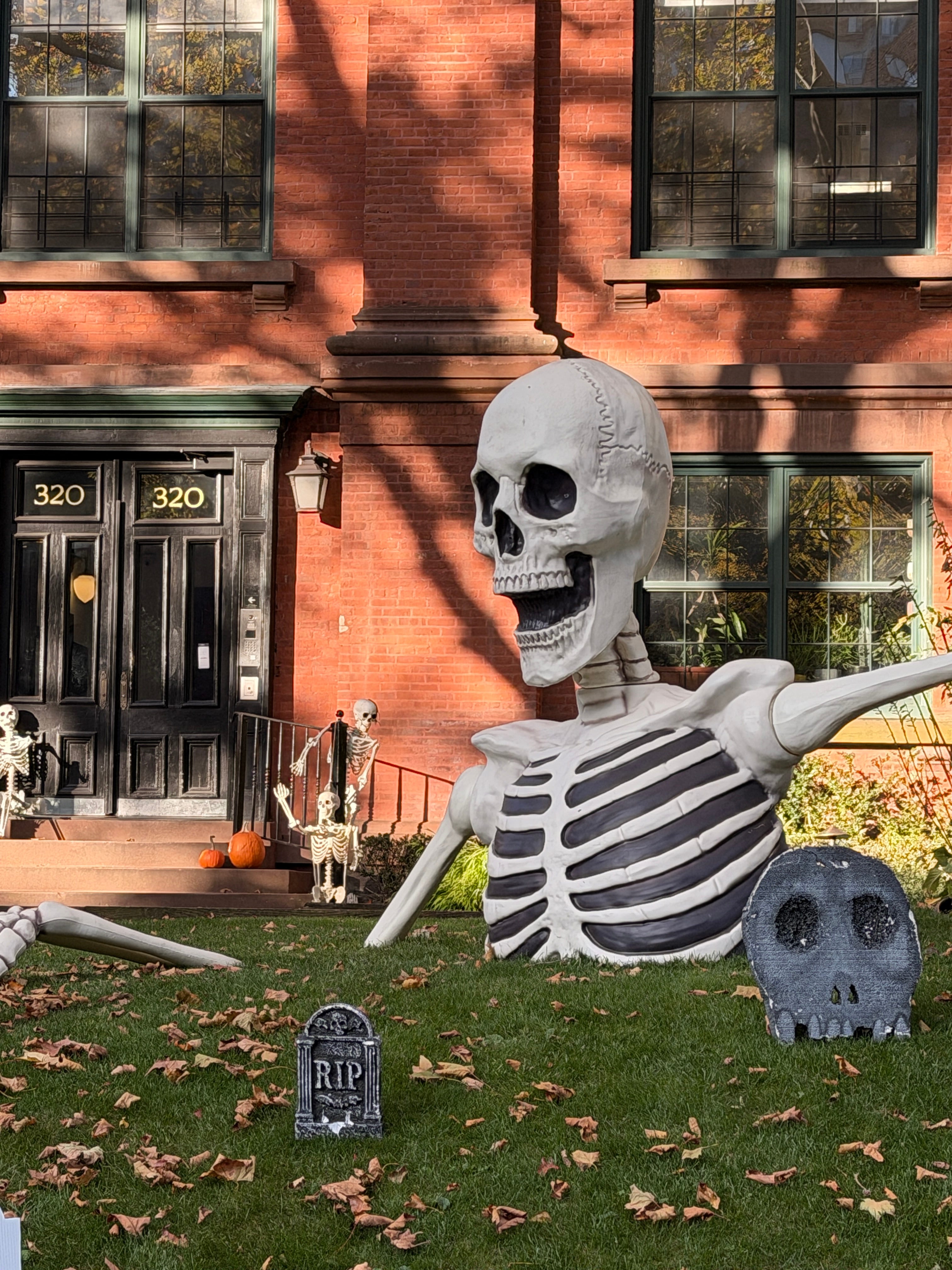
In a world where common decency seems in ever more scant supply, it’s hard not to imagine that the type of homeowner who would embrace this decorating philosophy would also choose to zestily engage in other generally civilization-eroding activities, like having a FaceTime conversation at full volume while dining alone at a nice restaurant, or vaping on a crowded commercial flight. You don’t need me to tell you how this homeowner likely renovated the kitchen over which Skelly stands sentinel. Like you, dear reader, I’d rather not think about it.
Of course, more could be said here about the Veblenesque aspect of Skelly as an unlikely signal of status in certain neighborhoods, and the willingness of a certain stripe of homeowner to happily drop 300 bucks for an enormous plastic structure that comes in a box that probably won’t fit in most passenger-grade vehicle trunks, that is massively time-consuming to erect once it finally gets home, and so on. Let’s save the exploration of those themes for the book-length version of this article, forthcoming sometime next year from The Home Depot Press.
II: “Et in Arcadia Ego”
And yet there is another fundamental aspect of Skelly-culture (Skellykultur?) that adds a still more unpleasant layer of detail to this whole grim picture, and that is the propensity of certain Skelly owners to disregard its original seasonal raison d’être and to just leave it up year round as general towering yard decor-cum-Vanitas, either out of sheer laziness or due to the difficult and time-consuming nature of erecting and subsequently dismantling it, or perhaps out of a perverse delight in the upsetting semiotic tableau it creates. These same homeowners will sometimes enhance the mash-up effect by gussying their Skelly up with key signifiers of other commercial holidays (Santa hat, Easter Bunny ears, etc.) at relevant moments in the calendar year. “Everyday is Halloween,” as Chicago-based industrial group Ministry famously framed it, way back in 1984. Except it isn’t—hence the disturbing effect of confronting Skelly during the frozen doldrums of late February.

This is actually more common than you might think, especially in rural areas. On your correspondent’s own regular drive to and from Northwest Connecticut, one encounters at least a few examples of this perpetual and ongoing Skelly deployment unless one chooses to take an alternate route that adds like a half hour to the drive, and the effect it has out of season is, shall we say, unsettling. Especially given the general state of the world at the moment and the direction in which things seem to be heading, and fast. To say nothing of the fact that these same rural Skelly owners also tend to proudly display Skelly-sized political signs emphasizing their spittle-flecked support for persons in the theater of global politics whose outlooks and corresponding actions are metaphorical rocket fuel for the troubling world-direction mentioned above.
And no, this is not just my overly-sensitive imagination or some fluke along the backroads of rural CT, because in the wake of Skelly’s runaway success, The Home Depot has introduced its own line of Skelly accessories for other holidays, and some accessories that are not holiday-themed at all, for owners who just want to treat their Skelly as a kind of enormous open-air, year-round memento mori with rotating costumes, a kind of overgrown and rictus-wearing American Girl Doll of death.
Other enterprising companies have also recently gotten in on the act, one such company being Arby’s, which now markets a Skelly-sized set of “Meat Sweats” sweatpants and shirt ($46.66 at Arbys.com), emblazoned with what appears to be an allover print depicting a close-up of the type of thinly-sliced and loosely folded sheaves of roast beef that typically spill forth from their signature sandwiches, and which frankly (at this scale or any other), yuck.
III: Gather Ye Rosebuds
Skelly’s proliferation since the first year of the COVID-19 pandemic has prompted a kind of giant-skeleton arms race, with Home Depot competitors selling their own versions to try to sop up some market share. Lowe’s has introduced a 12-foot mummy, and other big-box stores are peddling werewolves and witches of similarly titanic dimensions. Even as I type this, they are no doubt being eagerly assembled and tilted into place on lawns and stoops near you.
Maybe, in the end, it is in fact Skelly’s sheer size, and not its specific skeleton-ness, that has won the hearts of American home decorators. But one can’t help but wonder if those freshly unboxed witches and mummies will become permanent fixtures of their homes’ exterior decor, as Skelly so resoundingly has. A witch is already wearing a hat; maybe a red Rudolph nose will do the trick come Christmas? Time marches on.
In the days leading up to Halloween 2026, the owner of a home in Brooklyn’s Clinton Hill neighborhood that has displayed a Skelly figure each of the last four or so years, alongside a small flock of other plastic skeletons of various sizes, answered a reporter’s knock at his door. When asked what he found appealing about the enormous skeleton and why he chose to display it, the man replied, “It’s awesome. It really makes a statement. And have you ever seen a bigger one?” The reporter had to concede that he hadn’t. The homeowner added that he had intended to add the LED eye kit this year, but it had been sold out both in store and online. ⌂
Kevin Greenberg is the principal of Space Exploration, a Brooklyn-based design firm.
FROM THE ARCHIVE
PAST ISSUES
ISSUE 01: FINE, I’LL DO IT MYSELF ⌂ ISSUE 02: NO THOUGHTS, JUST VIBES ⌂ ISSUE 03: DON’T SIT ON THAT! ⌂ ISSUE 04: HOLIDAY SPECIAL ⌂ ISSUE 05: SWEATIN’ THE OLDIES ⌂ ISSUE 06: KITCHEN SINK ⌂ ISSUE 07: HACK JOB ⌂ ISSUE 08: OUT TO PASTURE ⌂ THE SHOE REPORT: MILAN DESIGN WEEK ⌂ A NYCxDESIGN CHORUS ⌂ ISSUE 09: GETTING WARMER ⌂ ISSUE 10: HOLDOUTS ⌂ ISSUE 11: HOME ECONOMICS
Daily Toil: Ravenhill Studio's "Everyday Objects"

"With a touch of art direction, these objects neither transform nor offer transcendence, but they do make strange the act of living." // By Mimi Zeiger
I definitely passed down the DIY value to my kid, and you’re right, the Skellys do tend to hang around all year in rural areas. A lot of the store-bought Halloween decor is, I imagine, legit terrifying to smaller kids and babies. It’s also the extremeization of Halloween decor. DIY is the way!
Yes, precisely.