
East Fork’s Big Bet
As the 15-year-old pottery doubles in size, it is proving that industrial production and handcraft can coexist.
Issue 08: “Out to Pasture” is presented by East Fork.
By Lila Allen
At East Fork’s production facility in Asheville, North Carolina, a hulking machine kicks out 2,000 pots per day. But close by—in the same building, actually—a tall Texan-turned-Carolinian named John Vigeland is hand throwing pots on a company wheel.
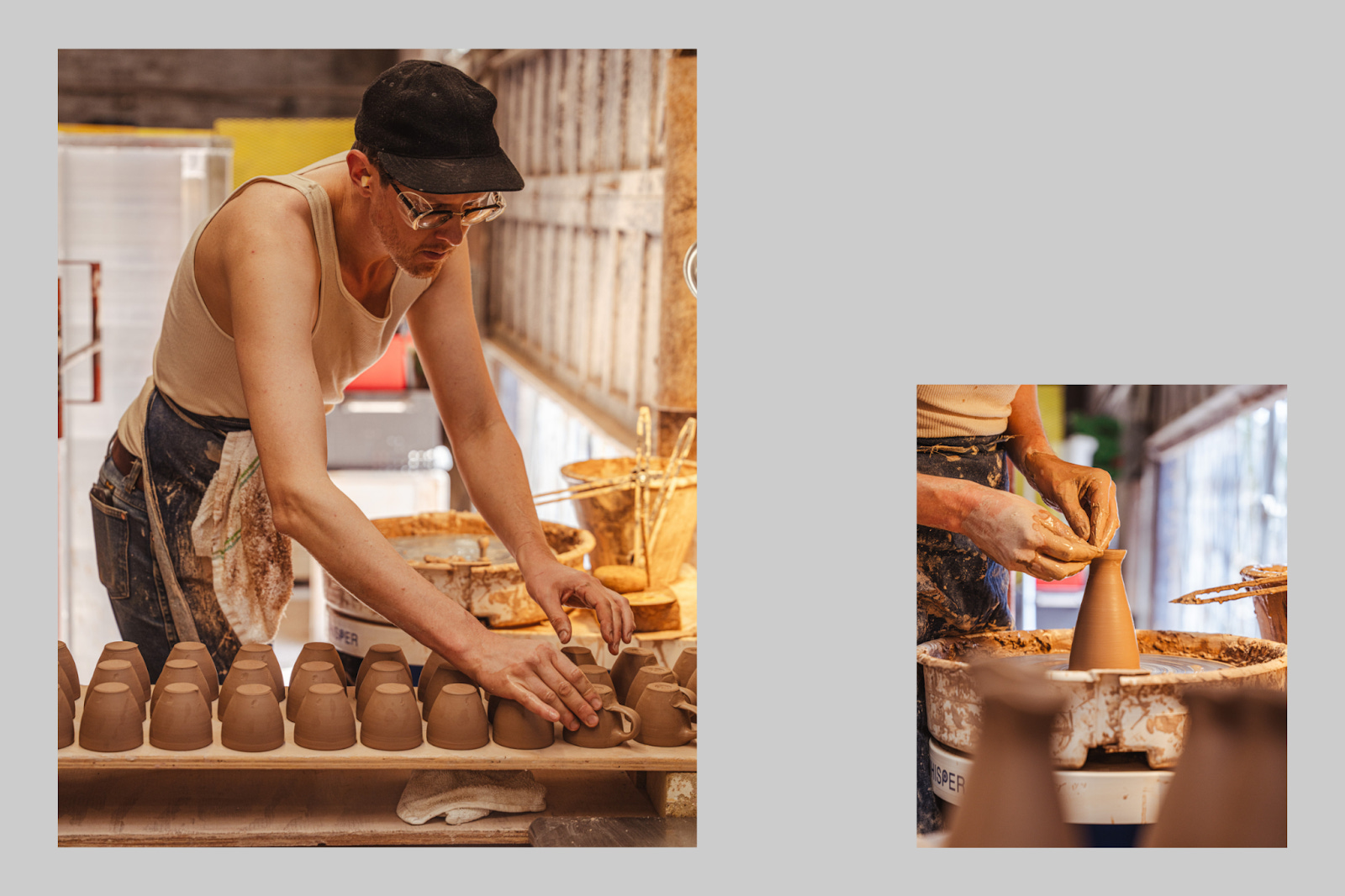
After a yearslong hiatus from the company—which he spent building a kiln—John is back in the saddle at the pottery. Formerly the brand’s CFO, he returns in a different role: re-envisioning the East Fork Workshop, where the company produces small batches of products made entirely by hand. A few weeks ago, the Workshop released a collection of espresso cups, mugs, and spoon rests. The coexistence of these two worlds—fast-paced, industrial-scale production on one side, and slower handwork on the other—embodies the tension that has long been at the center of East Fork.
This isn’t something the company is shy about sharing: Alex Matisse, East Fork’s cofounder (alongside his wife, Connie, and John), openly acknowledges this friction, which he feels acutely as the company’s CEO and a formally trained potter himself. “East Fork’s been growing, but it’s been a push,” he says. “It’s been a struggle to make the business model work at the heart of it while staying very stubbornly true to our mission and values and reason for being.”

And yet, here they are. Fifteen years after they first fired up the kiln on an erstwhile tobacco farm outside of Asheville, they’re producing 750,000 pieces per year—mugs, dinner plates, vases, and other vessels. They are on track to double that number in 2026, following a $2.5 million infusion that will go toward expanded fulfillment operations, new forming lines and kilns, and, for the first time, slip-casting equipment. Having outgrown their material suppliers multiple times, the brand is finalizing a decade-long effort to develop a more efficient clay body. They’re also expanding their bakeware, bringing in new partner lines of outdoor pottery from Whichford in the UK, and introducing new glazes—now collected by a community whose members call themselves “potheads,” and seek out “retired” colorways.
This push, as Alex calls it, comes after several years of reset that included expanding the team, shifting the leadership structure, and drilling down on the shapes and glazes that drive the brand. But the biggest reset might have been in 2024, when Hurricane Helene ravaged Western North Carolina—an area so far inland that a hurricane is nearly unheard of—and incited devastating floods, landslides, and power outages. East Fork, too, had to weather the storm: The building that housed the Small Batch Studio (now East Fork Workshop) was destroyed, along with production and studio facilities. During the worst of it, Alex and his team ran a “command center” from the Matisse house, using Starlink and a home generator to, quite literally, keep the lights on.
“We split up into groups. There was one team that was focused on getting the factory open as fast as possible, because if we’re not making pots, we’re not doing anything,” Alex recalls. “Another group was focused on the community, so we could double down with our [local] partners.” Sending out feelers to regional nonprofits, East Fork leveraged its network of followers and customers to drive awareness and reap support. While it will take years for the area to fully recover, Alex notes that this kind of collective effort has made a noticeable difference locally. “The tighter the community, the faster the recovery has been,” he says.
What happens next isn’t just about keeping production running; it’s about what’s worth making in the first place. And lately, even alongside the brand’s productivity push this year, that sometimes means doing things that don’t make business sense. “I feel strongly there are some things you just have to do—not because of their contribution to the bottom line, but because of their contribution to the brand and to the story,” says the CEO. To that end, Alex himself is currently hand-painting a limited run of pottery, which will debut next month.
For Alex and John, who learned the trade through traditional apprenticeships, this also means increasing access to similar opportunities. Alex and his team are asking, “How can we bring some accessibility into it, and connect folks that are working here? How can we break down this barrier, and talk about the hand and the machine?” With East Fork Workshop, which reopened last summer, Alex and John are scheming how it might serve as a site for R&D, as well as education.
Back at the East Fork factory, the machines are still running. John’s at it, too, spinning up pieces on the wheel—and even thinking about what a really big pot could look like in the world of this company. Much of this work scales, as East Fork’s 15-year trajectory has shown. But some of it doesn’t, and isn’t meant to. East Fork’s biggest bet yet is that they don’t have to choose. ⌂


