
How Abigail Castañeda Contains Her Creative Practice
The self-taught woodworker shares her rituals, rules, and priorities.
Text and photos by Alex T. Williams
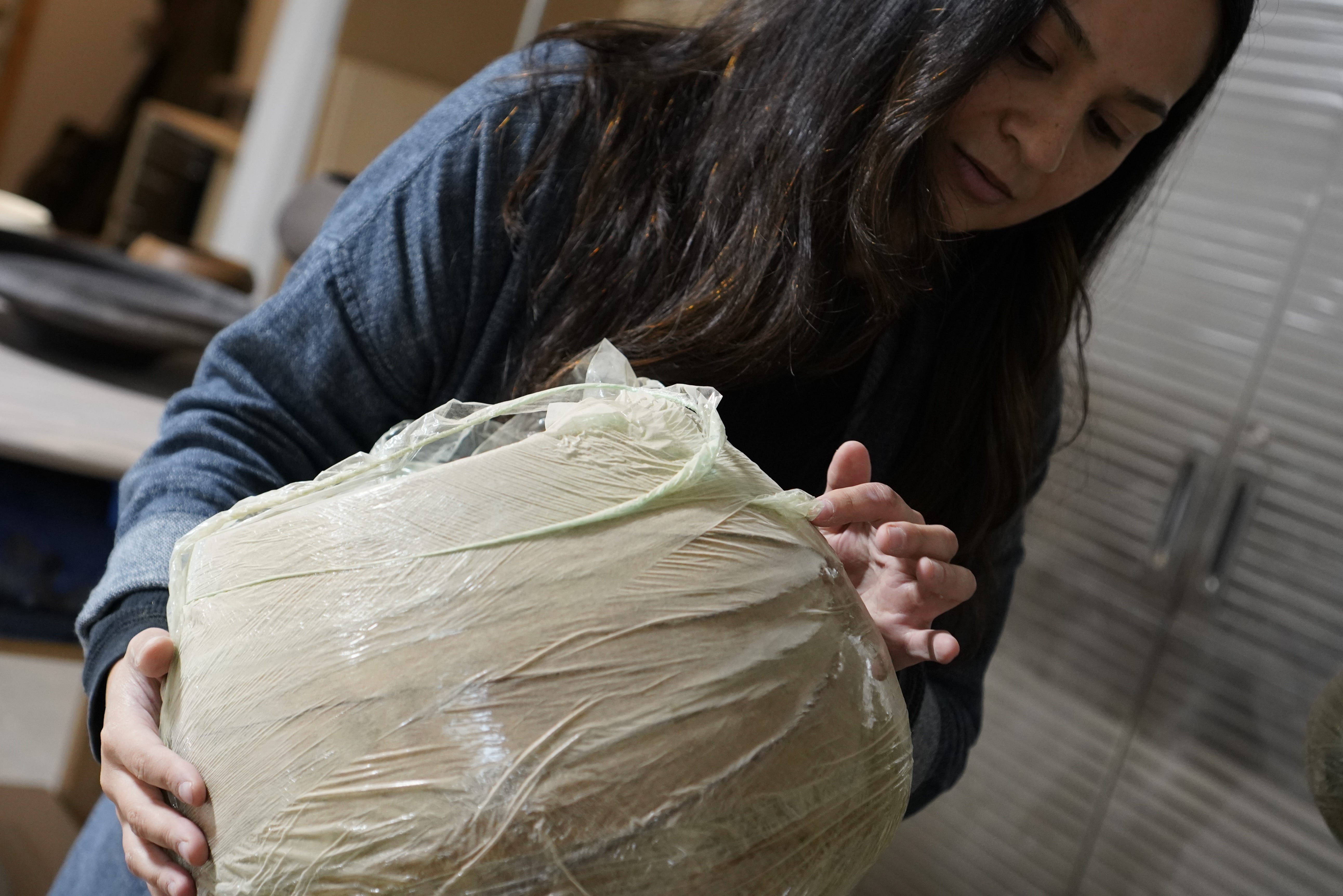
Last fall, I co-curated a studio crawl of some of the Hudson Valley’s best and brightest makers with Kombi gallery founder Fiona MacKay. We were nearly finished with the itinerary when Fiona emailed me, excitedly, with one last name: Abigail Castañeda—a Kerhonkson-based, self-taught woodworker known for coaxing impossibly delicate yet utilitarian forms from massive fallen timber.
When I first stepped into Abigail’s studio on a rainy October morning, I was struck by its sense of calm. It was less “workshop” than it was a space that had been deliberately reset. “Welcome,” she called from the back, stepping between towering blanks, machinery, and half-finished forms.
A student of Jungian psychology by night, Abigail came to woodworking through apprenticeship and stick-to-itiveness, starting her studio in 2019 after years of finding her way through the material. For her, turning is part meditative practice: part self-inquiry, and part refusal. In a world that can feel increasingly loud and jarring, her work demonstrates an insistence on attention, slowness, and beauty.
Filled with meticulously organized tools, taped-up poems, and small devotional objects, her studio is a place where things transform—wood becomes vessel, solitude becomes community, private practice becomes shared language. Known primarily for large, difficult-to-turn bowls, Abigail has made everything from urns to wedding cake pedestals. It feels fitting that her forms intersect with people’s lives at their most tender thresholds.
Describe a typical day in your studio—how it starts, how it flows, how it ends.
The day starts before even going to the studio. It’s the headspace that you’re in. I ritualize my morning—writing, a coffee moment, a little bit of exercise—then I go to the studio, do emails, look at my production list. I usually clean for a good 30 minutes first. It helps me set the stage and bring some newness into the space. From there, I’m just hacking away at material. A lot of physical work.
How do you wind things down at the end of the day?
The end is really [dictated by] the clock for me. Unless I have an approaching deadline, I’m good at looking at the time and saying, “Okay, close the book now,” so I can have a balanced evening—writing, reading, taking care of myself.
How does living and working here shape the pace and feel of what you make?
There are so many great things about the Hudson Valley—proximity to the city, culture, wonderful people, community. But there’s also the landscape and ecosystem, which are part of the community too.
I drive from New Paltz over the Shawangunk Ridge every day to get to my studio in Kerhonkson, so there’s this constant witnessing of changing landscape and weather. We just had 16 or 18 inches of snow that halted everyone driving. You feel the power and beauty of nature—cycles for stopping, blooming, creation.
Working with fallen trees as a kind of harvest creates an immediate sense of limit in terms of what you’re able to create and in the design. And at the same time, once you know the material intimately, you can design at a larger scale than you might with industrialized materials. But there’s still a deep sense of limit.
What feels most essential in your process right now?
Keeping a clear head. It’s a hard time to keep a clear head with everything going on in the world, and the speed of technology. Putting the phone away while you work—Do Not Disturb, in another room—and cultivating a container for your mind, your body, and the work feels essential.
You’ve said your work is tied to identity. How does making help you understand yourself?
We’re embedded in an ecosystem, and cyclical nature is something we inhabit psychologically too. Taking something that’s been lost—a fallen tree—and seeing it through a material transformation mirrors what happens in ecology, what can happen politically, and what happens psychologically: the need to change, to evolve.
For me it’s been breaking barriers—understanding limits I’ve had for myself, my life, my creative practice. It’s a mirror. And it’s given me a voice—something that can be democratizing.
What’s a personal belief you still struggle to hold onto?
That it’s important to create art, and that it’s valuable. Culture can make you believe there are more important things and better ways to help people. And that’s true, but art is essential in connecting people to beauty.
We’re in the middle of so many crises. Even with policy change—thinking about climate change, for example—that won’t necessarily help people fall back in love with the earth or with each other. Beauty might. It’s hard, in a world that can feel crushing, to hold that belief. But it’s meaningful to me to try—and to inspire others to do the same.
Is your practice problem-solving, meditation, or something else?
There’s a sense of creative power. But careful with that word, because there’s polarity there. For me it’s connecting to something larger, a creative force. Doing that by hand is embodied. You can intellectualize it, but it’s a feeling.
What are you learning about yourself lately?
That you can only go as far as you’re able to let other people into your life—to be vulnerable enough to do that. I had this idea I needed to do everything myself to be strong, but that’s not true. Sharing work is vulnerable. Sharing where you’re at is vulnerable. You need community. That feels essential.
How do you know when a piece is finished?
It’s hard to answer. Picasso said art is never finished; it’s only abandoned. In a production business, it’s finished when it meets the quality you strive for—the quality that brought you to make it in the first place.
Creatively, I don’t think pieces are ever finished. They’re continuations of ideas. I write every day; not everything comes to fruition. But themes repeat, and when I notice that, that’s where I try to go when I’m making work for myself—and hopefully sharing it.
Is stopping ever more important than pushing?
Absolutely. Cycles require stopping and reflection. We’re not meant to be machines. If you don’t stop, life will stop you.
There’s that parable of two woodcutters: one cuts all day, the other takes breaks—and uses those breaks to sharpen his axe. In the end, the second cuts more wood. You have to sharpen your axe.
Your bowls are functional objects—how important is use?
Incredibly important. There’s intimacy in what we use daily. We shape our tools, and our tools shape us.
But I don’t want to be one-sided. Seeing something visually—something without function—can still change you, inspire you, hold symbolic weight. Both are important.
What do you hope happens when someone brings your work into their daily life?
Curiosity toward the materials and where they came from—the idea that they’re living materials connected to the living earth.
There’s enchantment and wisdom in watching animals and plants—the discipline in the chaos of creation and destruction. I hope to bring some sense of beauty and relatedness into people’s homes.
What do you hope your work holds beyond the physical?
Trees are bridges. They go deep into the earth and reach toward the sky. Something ordinary and abundant is where reverence can come from. It doesn’t have to be extraordinary. It can be something simple that connects you to another world.
What feels alive or unresolved in your practice right now?
I’ve been in hibernation, and I’m excited to share my work more. I’m making conceptual but also functional pieces for an exhibition in the Smoky Mountains at Arrowmont called Crafting Eros.
What I’m stuck on is how to connect in meaningful ways with more people as the world shifts—how to stay connected to yourself and others, and keep the momentum and the spirit.
What are you curious about exploring next?
Writing. If I don’t write in the mornings, I feel bothered throughout the day. I’ve been writing every morning, and it’s tied to the creative work—developing voice around what I’m doing.
What do you hope endures?
Materially, you want the work to last. But beyond that, a legacy of craft—making things by hand, the power and simplicity of living that way.
Back in 2020, I was making pasta by hand almost every day. I made the drying rack, the rolling pin—everything by hand. There’s power in that simplicity. I hope that endures. ⌂


Love this