
The Architect Who Meets His Clients on the Dance Floor
From his rule-breaking Rock'n'House in Saugerties, New York, Christian Wassmann discusses building a practice on "magic moments."
Written and photographed by Alex T. Williams
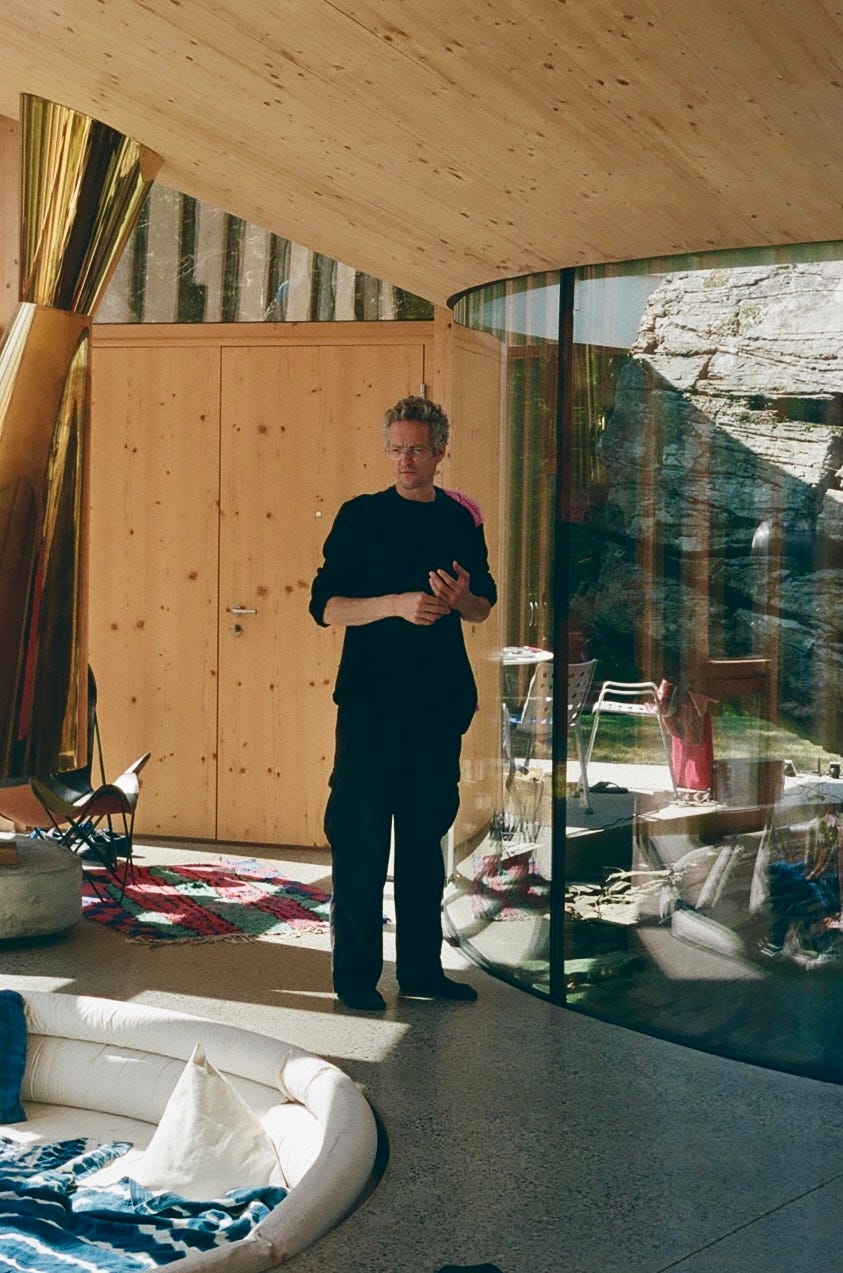
On a clear afternoon in late September, I drove to Saugerties to visit Swiss architect Christian Wassmann. Our meeting was at Rock’n’House, the residence he designed and built for himself and his family—one pole of a life split between the Hudson Valley and the East Village. The plan was simple enough: to scout the property and interview Christian, whom I’d only known by reputation and a few brief emails, as background for an event with StüdiGroup, my architecture and design focused adventure club.
But what unfolded was something far beyond a site visit. It was a reorientation—not only of my conception of what a house can be (part sculpture, part observatory, part vision quest) but also of how an architectural career can be built: through DJ booths and clubs, mountain tops and magic moments, fortuitousness and leaps of faith.
On our walkthrough of his home, a climate-positive cabin built around a glacial boulder in the Catskills, Wassmann narrated every detail. His stories revealed a deeply observational, sensitive approach. A polished brass banister was not simply a handrail—it was a viewing apparatus trained on Polaris, shifting slightly throughout the day. And so on. Later, we gathered around a Saarinen table on the home’s deconstructed ‘front porch’ and began to talk.
The afternoon became a kind of pilgrimage; a wide-ranging yet intimate guided tour through the mind of someone who treats space, music, and light as living materials. It was one of the most fascinating conversations I’ve had in a long time: unpredictable, funny, tender, cosmic, and utterly human.
I arrived expecting to meet a rational Swiss architect in his country home. Instead, I encountered a philosopher-builder; a man who connects humans to the cosmos, makes life decisions at Nick Cave concerts, meets clients on the dance floor, and grounds himself through transcendental meditation and chainsawing. He’s part mystic, part craftsman, part pragmatist—a tailor of the infinite possibilities of architecture.
Did you have a mentor or someone who inspired you early on in your architectural career?
The earliest inspiration was my dad, who was a jewelry designer, or my uncle, who was an architect living in Canada at the time when I was growing up in Switzerland. When I was a kid, he brought me to a lot of buildings and museums.
I came to New York in the mid-90s and started working with Robert Wilson, the theater director, who recently passed. He became, quite officially, my mentor for many years. I worked with him first as an assistant, then a collaborator, and later as his architect for his own loft in the city—his office for the Robert Wilson Arts Foundation, his archive, and his personal loft for living and exhibiting his collection. We stayed in touch up to shortly before his death, so I still consider him the most important mentor I had.
Then Steven Holl—I worked for him for six years when I moved to the States. Later, I taught with him when I already had my own firm, Studio Christian Wassmann; in ’06 I was teaching at Columbia with him.
What’s a favorite building that’s not of your own design?
I think the chapel Notre-Dame du Haut in Ronchamp by Le Corbusier is absolutely virtuous— the overall experience of that building, how it was built out of rocks that were there from a chapel that burned down after a lightning strike.
It’s an absolute masterpiece in terms of space, materiality, and inspiration. The story goes that he was walking on Long Island and found a seashell that inspired the roof. Fast-forward 70 years—his chapel roof was my inspiration for my roof here at Rock’n’House. There’s a lot of Le Corbusier in my own work.
His design all done before computers—paper models, sticks. There’s a particular book where he included the workers from the village who piled the stones the way he wanted. It’s an amazing building. Maybe we need to revisit it; I haven’t been there in about 10 years, but each time I’ve gone back, I’ve noticed new things—mostly because I had changed and learned along the way. I appreciated it more every time.
Maybe part of my journey to leave Switzerland was that, at 19—turning 20—I traveled extensively in South America. I was alone in Paraguay, Argentina, and then Brazil. In Brazil I started visiting every Oscar Niemeyer building I could find, knocked on doors, found my way in, climbed roofs—whatever it took. That was very formative for breaking me out of rational Swiss thinking. I did an apprenticeship as a draftsman from age 15 for four years. I designed buildings, drafted, and knew construction. But going to Brazil shifted my understanding that it doesn’t need to be a rectangle—a wall can be curved; glass can be curved. You see these influences in this house, too.
What’s a personal project that has stuck with you?
This house is the most important project I’ve done so far. I did a residence for a client in Miami called the Sun Path House that was important, but it’s less about the environment than this one. It reacts to its environment—sea-level rise will eventually flood the property, so the whole building is lifted off the ground, so it can be both in the water and still habitable. It’s sculptural and got a lot of attention, but people couldn’t fully identify with it, because it’s tailored to a very specific client—a loud, sweet, but loud playboy. That house has a very different feeling from this house, which I built for my own family, and is closer to what most people can probably imagine for themselves.
Have you ever been at a crossroads or fork in the road of your career? How did you navigate it?
Every day is a crossroads. We try to answer existential questions as we move along. I never had a business plan. The studio didn’t start as an idea that it could sustain a certain lifestyle, family, private schools—all the things that now pile up on my mind.
I don’t think we’re in a position to say no to projects right now. We’re doing everything from bookshelves in an apartment on up. Those bookshelves are almost an urban project, in a way, as they’re inspired by the 1811 New York City street grid. The client works in research and finance, and we found common ground talking about the early New York City grid, and thinking about how we could shrink it down to the scale of furniture.
Other crossroads are competitions we win, which are small but with big recognitions. Others are meetings with individuals—clients you click with—where you realize you can actually achieve a lot. They have a need and a site, and they come to us. My practice is strong in finding site-specific solutions—what we call the genius loci or spirit of the place.
For my own home, it was so important that we could come here for camping and BBQs and kids’ birthdays, and hang out under the rock and stargaze. Those things all led to this particular design. The first weeks of any project are always about spending time on site. Even in the city, when we designed Lisson Gallery, we did extensive daylight studies of what happens with the galleries across seasons. Is there too much sunlight? Not enough? What can we do to really make the building reactive to the site conditions?
We look for those “problem” moments, and consider the individuals we serve. We listen to those parts first, and then the site. I see architecture very much as what sits between the human body and the environment—that can be at every scale.
Sometimes, a crossroads is a dance floor. I’ve met most of my clients in social contexts. Those became my most meaningful clients. That first encounter leads to a daytime follow-up, a real meeting, and a project. Many of those clients turned into friends through the process, even with struggles and fights and disagreements—but you end with a finished project and an intact friendship. But many of these began late at night on a dance floor.
Did you meet your Miami client on the dance floor?
Frank Prisinzano, my first client for a radio station in the East Village—East Village Radio. The station manager was Echo Danon. Echo was an actress working with Robert Wilson and yes, we danced a lot. When I started my own firm, she knew that I liked music. I would count Frank from that category of early clients.
We built that radio station in two parts. Similar to this house, I gave the drawings to a carpenter, and the carpenter couldn’t build it, so I wound up building it myself. We became friends, and that led to future artist collaborations—a suspended DJ booth for Terence Koh’s space, or for Agathe Snow during the Whitney Biennial we built a DJ booth at the Park Avenue Armory, etc. All because they saw me in that tiny glass box on 1st and 1st.
The crossroads question is a very important one. As a kid, I used to follow my intuition a lot. Or I was encouraged to listen to it — to not just be driven by schedules. And I realized my entire life that I was often in the right time at the right place. I didn’t always know what was the right thing to do or say. So that’s maybe what the learning is. Crossroads were me being in the right time at the right place.
I still live by that mantra—being as present as I can in that moment—which explains why I’m sometimes a bit slack in my response to emails and so on. But if I’m present, I’m present. From encounters at the supermarket to the dance floor late at night, I want to be present.
When you’re feeling stuck, worn down, in need of inspiration, how do you recharge creatively?
I meditate—Transcendental Meditation—which I’ve done for about 10 years). I run. I dance at clubs and also at Five Rhythms, a two-hour dance class I started recently that changed a lot for me.
I have too many ideas. I carry sketchbooks, and try to write down what people tell me. Even though we have Google and use AI, the sketchbook is all I really care about—it contains traces of all my encounters. My ideas develop there; for me, it’s the fastest way of thinking.
How do you filter those ideas and avoid spreading yourself thin across too many things? How do you maintain momentum?
Benchmarks and the team—deadlines, clients, budgets. It was my birthday yesterday, I’m a double Virgo, Swiss, and an architect, so I have a very rational side. But I can also be very chaotic in my thinking.
The pandemic changed our studio’s routines. We went from in-person teams of three to ten to more distributed work. People scattered and no longer wanted to work in person. I realized that I don’t need to be in person either, as much as long as there are other ways of communicating. It’s tricky because, like I said, there’s no strict business plan; instead, we anchor to specific project schedules and benchmarks.
Do you enjoy that part?
It’s a challenge—I have to get better at it. When you’re on your own, you aim for something. I’ve never been good at compromises. I’m happy I didn’t, but it can be scary because it’s unpredictable.
We do a wide spectrum of work, from furniture and lamps that spin out of projects and take on a life of their own, to practical solutions to specific problems that then get reproduced. All of my mentors worked across a spectrum of things—from artist collaborations to more pragmatic architecture. Cross-pollination is essential.
In that vein, my teams often include people from different fields, or with extreme hobbies that make them stand out. Sometimes those interests eventually take over, and they become choreographers, artists or other things that have nothing to do with what we did in the studio.
If you couldn’t practice architecture anymore, what would you pursue?
Professional dancer… [laughs]. I really like working with my hands. I never gave up folding papers and building models, but then building this house reignited that longing for doing things with my hands.
I might go get gas for my chainsaw and take some dead trees down. Working hands-on—crafting furniture — I could see that. It’s a romantic idea: not relying on clients or budgets—just cutting, making, eventually selling. The romantic in me wants to just be living here building stuff, and I could be satisfied.
But I also like planning. This house was a lot of brainwork before it was anything else.
What makes for a dream client or project?
I used to want clients from the art world because of our shared sensibilities for quality, aesthetics, and conceptual language. But lately, I’m glad we’ve widened the pool: to people who are curious, open to ideas, not too conservative, ready to engage in finding a perfect solution tailored to them, like a suit. It’s like, yes, there are good suits on the shelf, but maybe you’re shorter than most, or your arms are too lanky. In those cases, you actually profit from a custom suit. Not everything needs custom tailoring, but when it comes to your personal house, there’s not enough custom tailoring in America.
Part of why I left Switzerland was feeling there was a bigger need for architects in chaotic New York, where people don’t always know what architecture can do for them.
What’s something you wish every client knew before starting?
Possibilities are (almost) infinite—but that doesn’t mean picking from infinite options. You can truly arrive at your own solution: you don’t need cookie-cutter windows and pitched roofs. Shapes can follow sun angles—which is one reason this house looks so different from most—rainwater collection, and so on.
I want clients open to a radically unique building, apartment, or piece of furniture they couldn’t get elsewhere.
For Luisa and me here, the big challenge was budget, but we also knew we designed a house for our future. We started with a cabin dream in the forest. But we thought, if we do X, Y, Z, it can really be a family house. You trust a process that serves future needs, not just where you come from. It requires a leap of faith.
You’ve talked about encounters on the dancefloor shaping your professional life—how else has art or music shaped your work?
I see a lot of art—from small performances by emerging artists to long hours at MoMA just looking and feeling. I don’t treat it as an intellectual practice—it’s exposure. Good art looks different every time you return.
Recently, Nick Cave at Barclays Center blew my mind. I saw him 25 years ago at Roseland, but this time it was voodoo—somewhere between preaching, singing, talking, philosophizing, and rocking. 10,000 people singing along.
A key moment was seeing Prince when I was 18—first in a crowd of 25,000 in a soccer stadium; then up close, at an after-hours show with 1,000 people. It was life-altering, and a surge of energy I’ll never forget.
A similar moment of awe inspired my work with Robert Wilson. I saw Wagner’s Lohengrin at Zurich Opera House, which Robert had worked on. Then I read in the program that he had a center in Watermill, Long Island, where he worked with a cross-disciplinary group including architects. I was like, oh wow—and I began to investigate how I could participate.
I would get last-minute student tickets alone, then I would see friends for dinner, then we would go clubbing. At these hip-hop and house parties nobody knew I started the night at the opera.
Bob Wilson was visual and acoustical. His breakthrough was Einstein on the Beach with Philip Glass in 1976. It’s extremely slow, with striking images. I just knew there was something between music—my passion—and something visual or architectural I could relate to professionally.
Before I knew the word awe, I would refer to “magic moments”—instances where I would make major life decisions while listening to music or in front of a Rothko painting. I suppose that goes back to the idea of crossroads.
Architecture isn’t “art.” It’s pragmatic, functional building, but you can still create awe with certain choices. I think it’s not happening enough in architecture discourse these days. Nobody talks about beauty or poetry at the moment—the cosmos. It’s forbidden. The old churches had that alignment, and I want to do that in a contemporary way.
Looking back at your career and life—what would you tell your 18-year-old self?
Trust. There was insecurity in my life—some self-inflicted. Leaving your country isn’t for everyone; I had no rational reason to go. Traveling in South America at 19, I was homesick and didn’t know Spanish, but I learned to dance and communicate through rhythm.
I wouldn’t tell myself to be less insecure, because the doubts mattered. I’m still doubtful, but I’d say: trust the process.
I recently returned to Monte Verità in Ticino, an early 20th-century artist community. During World War I, when Europe was shut down, people fled to Switzerland. There is a Bauhaus hotel there, in Ticino. I first went there when I was 13, and a Boy Scout. Thirty-seven years later I returned and had so many flashbacks—back to the insecure me, sleeping in tents.
I had so many questions about life, but I somehow knew I would eventually have a life somewhere else and do whatever I dreamt of. So my message to my younger self is just: do it. Don’t fall into clichés or traps. Stay independent, stay on your feet, keep dancing. ⌂
This interview has been edited for length and clarity.


