
What's in a Name?
Stewardship of old things is the point at both Nameless Art + Design and The Winter Show—but they practice it through different systems.
By.Lila Allen
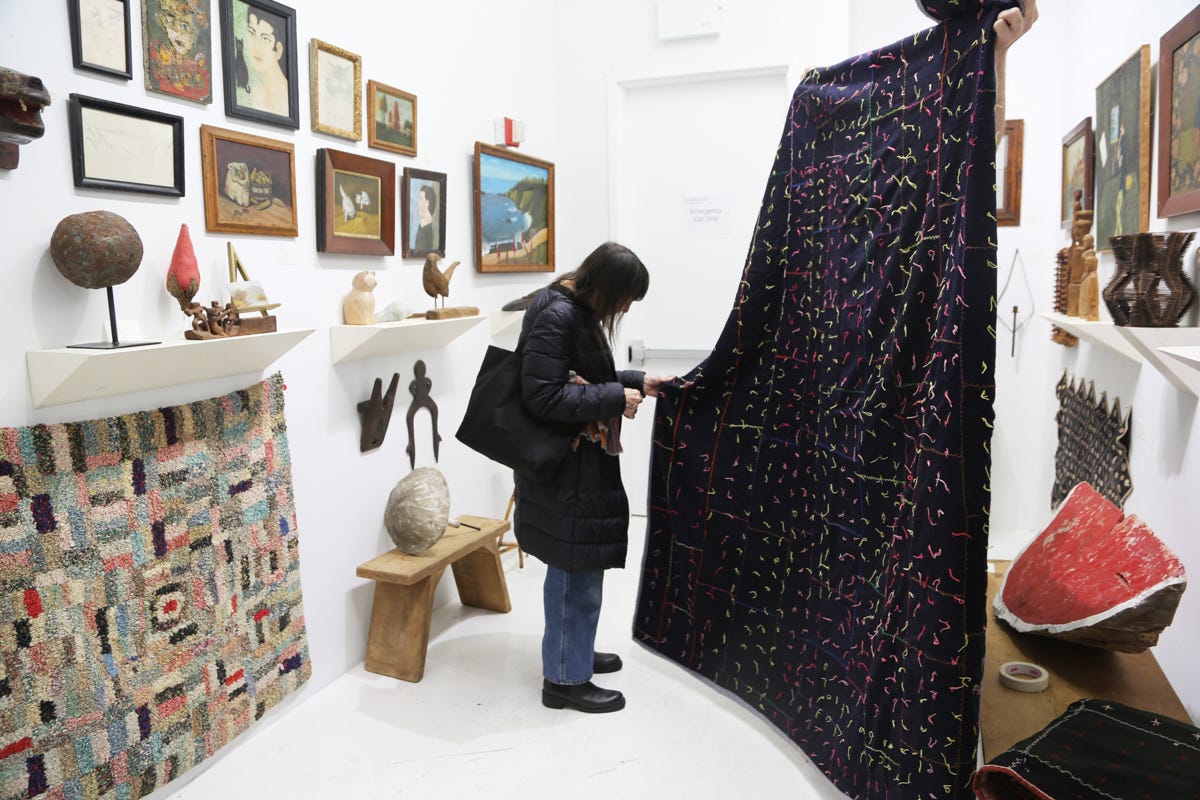
During Antiques Week, New York City briefly becomes the capital of the world of old things. On the east side of town, The Winter Show transforms the Park Avenue Armory into a mini-museum covering 5,000 years of blue-chip furniture, ceramics, paintings, jewelry, and works on paper, each of them vetted and approved by an army of experts. Three miles away, in Chelsea, Nameless Art + Design stages a more plainspoken presentation, the organizing principle of which is that the maker is little known, if known at all. There, over three days, some two dozen vendors sell folk art, found photos, and American vernacular design, more often than not made without the kind of attribution that tends to cement an object’s place in history.
This will be Nameless’s third year running when it opens on January 30. The Winter Show, by contrast, has been operating since the 1950s, when it was established as a benefit for East Side House Settlement. Its executive director, Helen Allen, remembers going for the first time when she was five years old, and can still recall the giant antique clocks that were on offer then.

Adam Irish, the organizer of Nameless, also got an early start in the antique game. As a kid in New England, he dug up broken china, old medicine bottles, and toys that had been dumped behind the barn by someone decades before. “That was the most magical thing to me, because you could enter people’s lives,” he says.
With Nameless, he’s still doing that. While many of its objects—brought in by dealers like Albucker Gallery, Battle Brown, Powers Lowenfels, Tihngs, and Portmanteau New York, as well as Irish’s own shop, Old As Adam—may not always have well-manicured provenance or a recognized author with formal training, they do offer something important that isn’t often as articulated in the antiques market: an appeal to shared experience.
“There’s something about having an incomplete story that can make a work even more powerful, because it opens our imagination and demands an empathy that doesn’t have a readymade place,” he says.

To Irish, the “granny note”—documentation left by an older relative for future generations—is a holy grail for completing the picture. While reference materials and chain of custody are things that Irish champions as an antiques dealer, he points out that objects missing them are often at risk of being lost entirely. With much of the marketplace having moved online, keyword-driven search has consumed what gets virtually found and sold. That leaves items like the ones at Nameless in a precarious spot.
“We are so groomed by our image-serving devices that we think that what we’re witnessing at a show like Nameless is this endless stream of images that should just keep on flowing,” explains Irish, “when, in fact, these are objects on a conveyor belt to destruction, unless we take the object off it and treasure it ourselves.”

If a marketplace can intercept those pieces before they’re lost, they’ll have a fighting chance at long-term survival, Irish posits. He hopes that Nameless can act as a kind of “Petri dish” for beginning scholarship and offering opportunities to go deeper.
At The Winter Show, the metabolism looks a bit different. The objects displayed there—which this year range from Greene and Greene architectural artifacts to a gilded table from Queen Mary II’s Kensington Palace bedchamber—are documented, catalogued, reviewed digitally, and then evaluated again in person for airtight attribution and provenance. “It doesn’t matter if it’s glass or ceramics or furniture or painting or a gem or jewel, it’s really about the highest level of craftsmanship,” says Allen. This level of scrutiny, she adds, is “to give our visitors and collectors a sense of security, knowing that experts—whether they’re conservators, curators, dealers, or scholars—have really examined the work for its condition and its provenance.” Allen points out that there are a few works by anonymous makers there too: ancient items where the maker is unknown, like Egyptian masks, and 19th-century game boards, which are being presented by Ricco/Maresca. “They become these abstractions—very folk art in expression. But we don’t know who made those.” But those objects are in the minority.
Attended by curators, collectors, designers, and social groups, The Winter Show is ultimately a site of exchange. The works are for sale, even if you experience them a bit more physically than you can at an institution like a museum. (Handling is accepted.) But Allen calls education a “key component” of The Winter Show’s mission. To that end, they host students and special-interest connoisseur groups like the Fine Objects Society, in addition to putting on a multi-day schedule of programming. “We’re really about connecting the past and the present, scholarship and connoisseurship, established collectors and those that are just curious and want to have a wonderful day out and discover,” says Allen.
Though their scaffolding might be different, both fairs work in parallel to keep our material past in circulation. Irish explains that assigning dollar amounts—even to difficult items—is a requirement for that process. “We live in a world where… if something does not have a value—even if it doesn’t have a value for a moral reason—it goes in the dumpster.”

In a split screen between The Winter Show and Nameless, there are two sides of Antiques Week. In one, a collector receives reassurance: that artifacts are named, authenticated, and given a stamp of approval. The other asks us to reconsider the objects that never received that treatment. What they share is a proposition with major stakes for our preservation of the past—that what gets named, displayed, and bought might survive. The rest goes on the conveyor belt. ⌂


Such a great read, such a great point. Vintage, nameless, antique, found, collectible... some categories hard and soft. I think the difference is the kind of story that's told—or available to be told. But at the end of the day...it's about love. Was just at an antique show with lots of lofty, elevated things. And I was smitten with probably one of the humblest, least storied pieces there. But I love its form, its mystery.
I believe that conveyor belt comes straight to my attic.